






































AI and sustainability drive next robotics wave
31.12.2025
With automation demand rising, Mitsubishi Electric introduces user-friendly robots designed for easy integration and to counter the shortage of skilled workers.
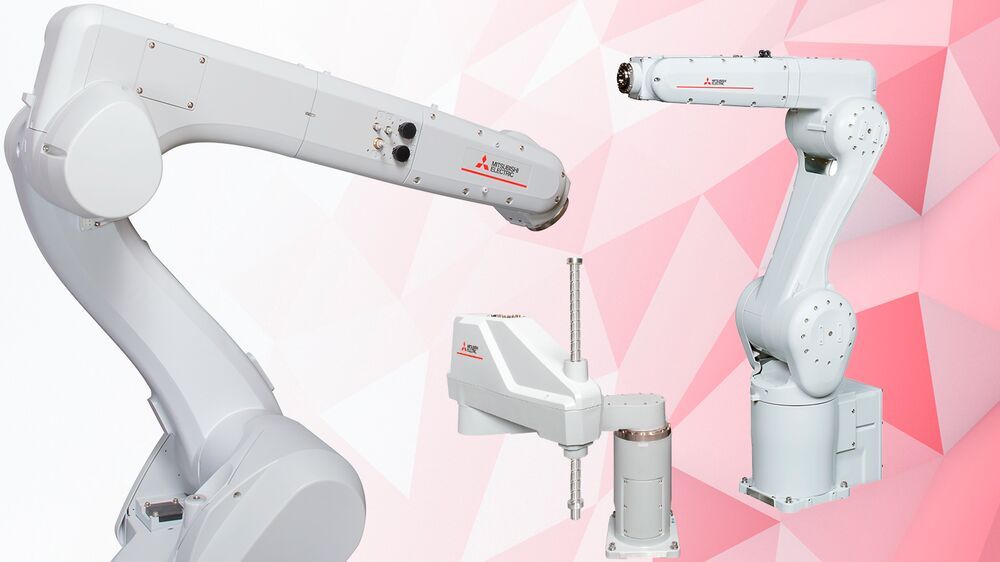
Photo: Scara and articulated arm robots from Mitsubishi Electric's CR series.
Source: Mitsubishi Electric Europe
The global use of industrial robots remains high. According to the 2024 World Robotics Report published by the International Federation of Robotics (IFR), there are more than 4.28 million robots in use, which is a 10 percent increase from the previous year. In 2023, 541,000 new units were installed, marking the third consecutive year exceeding half a million. China remains the leader, accounting for 51 percent of all installations, followed by Japan, the United States and South Korea. India and Brazil are also experiencing double-digit growth rates. These figures demonstrate that robot technologies are increasing production capacity and being successfully integrated into existing processes.
In 2023, 92,393 robots were installed in Europe (+9 percent), with Germany as the largest market with 28,355 units (+7 percent). The United Kingdom even recorded +51 percent with 3,830 units, driven by the automotive industry.
According to the IFR, 2024 saw the first signs of stabilization or a slight decline in installations, particularly in saturated markets. In Europe, for example, around 23,000 new robots were installed in the automotive industry, the second-best result in the last five years. In the long term, however, the IFR expects growth rates to rise again from 2026, driven by AI, new applications, and nearshoring.
AI and sustainability will shape 2025
The IFR sees significant momentum in 2025 from analytical, generative, and physical AI, humanoid robots, and sustainable robotics. New industries such as construction and laboratory automation are gaining in importance. At the same time, the shortage of skilled workers remains a key issue: According to a McKinsey Global Industrial Robotics Survey, 61 percent of companies cite a lack of automation experience as an obstacle, while 30 percent complain of difficulties in recruiting qualified employees.
No-code approaches to combat the shortage of skilled workers
This is where Mitsubishi Electric comes in with its Melfa RV-CR (articulated arm robot) and RH-CRH (Scara) series, offering compact, cost-efficient solutions that are particularly easy to use. The CR800 controller enables visual programming via function blocks, allowing even employees with no prior knowledge of robotics to implement applications. The Melsoft RT Toolbox 3 software allows simulations to be carried out in advance, reducing programming effort and minimizing errors.
The demand is there, both in large and small production facilities. The Melfa RV-CR and RH-CRH series were specifically developed as cost-effective and compact solutions for a wide range of applications.
Easy integration and low maintenance
According to the Syspro study, 30 percent of manufacturers have problems integrating new technologies. The two robot series are therefore optimized for quick integration into existing production lines: compact design, integrated cabling and pneumatic lines, and battery-free servo motors reduce maintenance requirements. The new R86TB teaching box with a 10.1" display and 3D visualization makes setup, diagnostics, and programming easier with — compatible with current and previous Melfa robots.
Wide range of applications and user-friendliness
Typical applications range from picking, packaging, and sorting to quality control and assembly in the automotive industry, laboratories, mechanical engineering, and other industries. Thanks to support for the eF@ctory concept and compatibility with CCLink IE TSN, the robots can be seamlessly integrated into industrial networks.
Two series for different needs
Mitsubishi Electric has introduced two robot series for manufacturing environments.
- Melfa RV-CR series: Vertical articulated arm robots with a compact design and low maintenance requirements, ideal for industrial applications.
- Melfa RH-CRH series: Scara RA robots with 65 percent lower height and 50 percent less weight than the previous FR series — optimized for small footprints, fast cycle times, and standard network connectivity
Combining user-friendliness, energy efficiency, and flexible integration, the Melfa RV-CR and RH-CRH series offer a real answer to the shortage of skilled workers and increasing automation requirements — even in new industries outside of traditional manufacturing.
Published on: www.etmm-online.com
More information: www.mitsubishielectric.com